Google Data Meets Traffic Police: Will Staggered Timings Actually Fix Pune’s Chronic Choke Points?
Solving Pune traffic congestion has long been a daily test of patience. Commuters routinely lose hours in gridlock at familiar bottlenecks—Navale Bridge, Wagholi Chowk, the approaches to Hinjewadi, Hadapsar stretches, and narrow underpasses in Ravet, Punawale, and Tathawade. During the recent festive rush, some 15-km journeys stretched to 90 minutes or more.
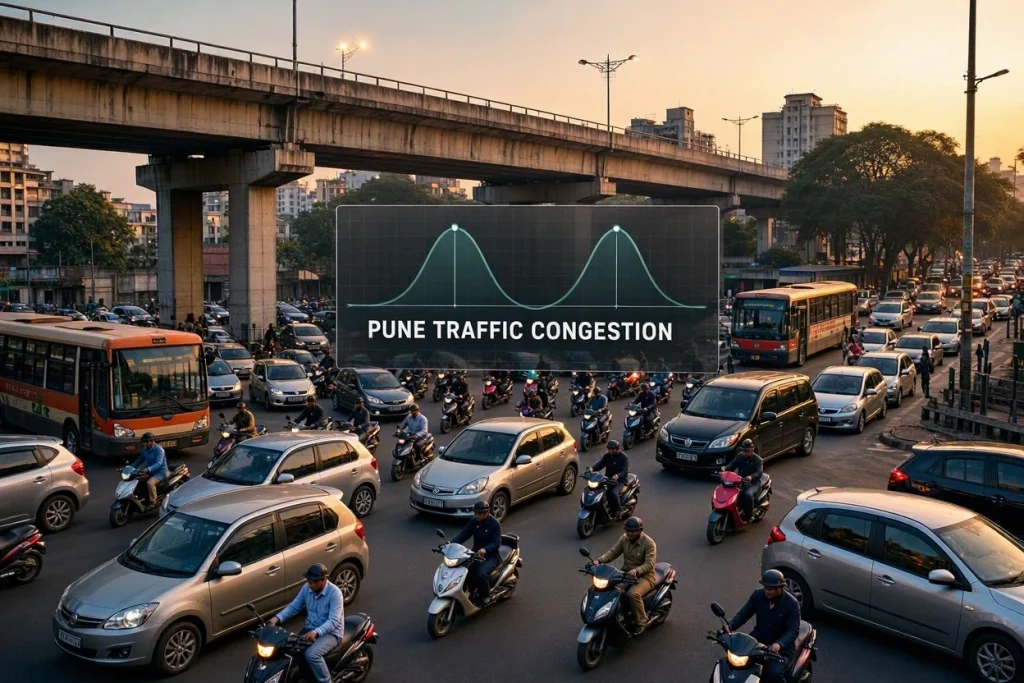
(Image: AI-generated for PuneTV)
Now the city’s traffic police are pairing real-time Google data with a classic demand-management idea: staggered timings for offices, schools, colleges, and businesses . The question is whether this combination of big data and administrative fine-tuning can deliver lasting relief, or whether it will merely rearrange the congestion.
Google’s Eyes on Pune Traffic Congestion
Pune became the first Indian city to deploy a Google-powered online traffic management system, known as Trafficure. Built after a state-government MoU with Google India, the platform draws on Google Maps data to monitor congestion, slow-moving traffic, and related issues in real time across roughly 550 zones . Officers receive live alerts and can respond from control rooms or the field. Early results were encouraging: average vehicle speeds on major corridors rose from about 20 kmph to 26.8 kmph in the initial months of use .
The latest step goes deeper. Traffic police have analysed the “anatomy” of congestion—how often jams form at each location, how intense they become, how long a vehicle takes to clear the bottleneck, and how long the jam itself persists. Additional Commissioner of Police Manoj Patil has described the study as one-of-a-kind and said the insights will guide both major infrastructure priorities (flyovers, underpasses, road widening) and smaller, faster interventions .
Pune Traffic Congestion: Staggered Timings Enter the Conversation
While concrete and asphalt solutions remain essential, Patil has publicly stressed the limits of supply-side fixes alone. Continuous road construction cannot keep pace with rising vehicle numbers and urban expansion. “Among smaller measures, we can stagger the timings of, say, businesses, companies, schools and colleges,” he noted . Spreading peak demand across more hours of the day reduces the simultaneous load on the same choke points.
This is not a new idea. Earlier discussions in Pune and other Indian cities have suggested that well-designed staggered or flexible hours can cut peak-hour congestion by 10–15 percent in targeted corridors. In IT-heavy zones such as Hinjewadi, different companies starting or ending shifts at offset times could smooth the flow through the underpasses and junctions that currently bottle up thousands of private vehicles every morning and evening.
Why Pune Traffic Congestion Persists at Choke Points
Data and management tools help, but they do not erase structural problems. At Navale Bridge, highway traffic converges with local residential and commercial flows; wrong-side driving or a single poorly timed bus can cascade into long delays. Wagholi struggles under the combined weight of school buses, corporate buses, construction trucks, and limited alternative routes. Hinjewadi approaches suffer from heavy private-vehicle dependence, weak last-mile public transport, and occasionally non-functional signals. Central junctions near the RTO face physical constraints from railway land and the river, leaving little room for widening.
These locations share common traits: rapid growth outpacing infrastructure, mixed traffic (two-wheelers, cars, buses, trucks, pedestrians), limited network redundancy, and peak periods when office, school, and commercial traffic coincide.
Will Staggered Timings Fix Pune Traffic Congestion?
Potential upsides
- Redistributes demand without requiring years of construction or large capital outlays.
- Complements the real-time visibility that Google data already provides—police can measure whether peak loads actually decline.
- Can be introduced area by area (for example, IT parks first, then schools in specific corridors) and adjusted based on observed results.
- Reduces pollution and fuel waste associated with prolonged idling.
Real constraints
- Coordination is difficult. Private companies, schools, colleges, and government offices operate under different constraints—client meetings, examination schedules, parental logistics, shift work in manufacturing or services.
- Incomplete adoption can simply shift the peak rather than flatten it. If only some institutions change timings, new secondary peaks may form.
- Enforcement and incentives matter. Without clear guidelines, monitoring, and possible benefits (or mild penalties for non-cooperation in high-impact zones), voluntary schemes often remain limited.
- Staggered timings address when people travel, not how. Without stronger public transport, better last-mile options, parking management, and junction redesign, private-vehicle volumes will continue to grow.
Past experience elsewhere shows that staggered hours work best as part of a package: dynamic signal control, targeted enforcement against wrong-side driving and illegal parking, junction re-engineering, and gradual improvements in bus and metro connectivity.
The Bigger Picture: Solving Pune Traffic Congestion
Google data has already given Pune traffic police sharper eyes and faster response capability. The detailed congestion study now under way should help prioritise scarce resources for the worst hotspots instead of spreading interventions thinly. Staggered timings represent a low-cost, high-leverage demand-side tool that can buy breathing room while longer-term projects—grade separators, missing road links, Metro expansion, and public-transport upgrades—come online.
Success will depend on three things: rigorous measurement of before-and-after speeds and delays on key corridors; genuine buy-in from major traffic generators (IT parks, large schools, commercial hubs); and continuous coordination between traffic police, the Pune Municipal Corporation, PMRDA, highway authorities, and public-transport agencies.
Pune’s chronic choke points will not disappear overnight. But the combination of Google-powered visibility and deliberate spreading of peak demand offers a pragmatic path forward. If the data continues to guide action and staggered timings move from suggestion to coordinated pilot, the city may finally start turning the daily gridlock into something closer to manageable flow.
Also read : floating-solar-mulshi-tata-power-water
