SRA Pune Slum Rehabilitation: 51,000 Flats Target for 2026
(Credit: srapune.gov.in)
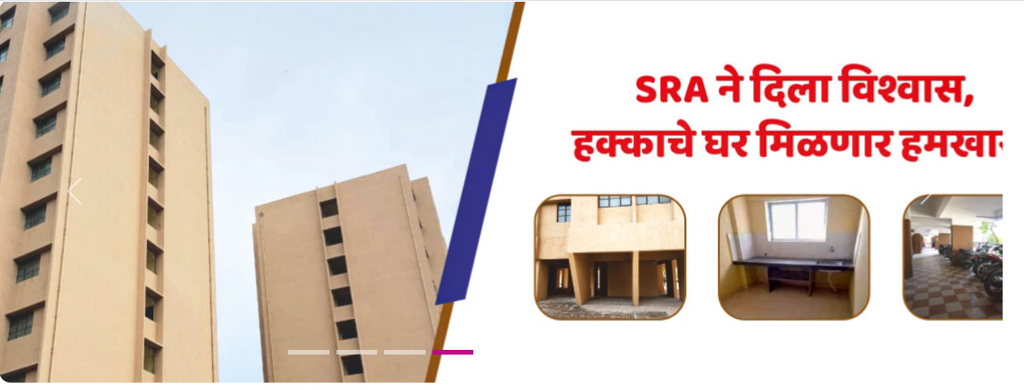
SRA Pune Slum Rehabilitation has become one of the most important urban housing programmes in Maharashtra. With roughly 486 slums housing about 1.65 lakh families within Pune Municipal Corporation limits, and another 71 slums with over 35,000 families in Pimpri-Chinchwad, the Slum Rehabilitation Authority (SRA) Pune is reshaping the city’s housing future.
But what does SRA actually do? Who is eligible for a free flat? How does the scheme get funded? And what is the current progress in 2026?
Here is a complete, practical guide.
(Credit: srapune.gov.in)
The Slum Rehabilitation Authority Pune is a statutory body under the Maharashtra Housing Department. It was established by the state government through a notification dated 30 June 2005, under Section 3A of the Maharashtra Slum Areas (Improvement, Clearance and Redevelopment) Act, 1971.
Its jurisdiction covers:
- All areas under Pune Municipal Corporation (PMC)
- All areas under Pimpri-Chinchwad Municipal Corporation (PCMC)
- Certain notified portions of PMRDA (including former PCNTDA areas)
- Notified MIDC zones within these limits
Its mandate is fourfold:
- Survey and review slum areas
- Formulate and implement Slum Rehabilitation Schemes (SRS)
- Act as a single-window clearance agency for all approvals
- Determine eligibility of hutment dwellers, approve schemes, register societies, and allot tenements
The model is broadly similar to Mumbai’s well-known SRA framework.
How the SRA Pune Slum Rehabilitation Model Works
The SRA operates on a cross-subsidisation model. This means the government does not directly fund the construction of free housing. Instead, private developers build the housing — and recover their costs through the sale of additional market-rate flats.
Here is how it works step by step:
Step 1: Slum Identification and Survey
A declared or notified slum is selected for redevelopment. A detailed survey is conducted, and an Annexure-II list is prepared naming every eligible hutment dweller.
Step 2: Free Rehabilitation Component
Every eligible family is entitled to a free residential tenement of approximately 27.88 square metres (300 sq ft) carpet area — including balcony, bathroom, and toilet.
These free flats form the Rehabilitation (Rehab) Component.
Step 3: Incentive / Sale Component
To compensate the developer, the SRA grants extra Floor Space Index (FSI) beyond the normal permitted limit. This extra construction is called the Sale Component.
The developer is allowed to sell these extra flats, shops, or commercial spaces at prevailing market rates.
Step 4: Cross-Subsidisation
The developer spends money to build both the free rehab buildings and the sale buildings. The profit from selling the sale-component flats covers:
- The cost of building the free flats
- Infrastructure like roads, water, drainage, society offices, and balwadis
- The developer’s profit margin
In short: buyers of the market-rate flats indirectly subsidise the free housing given to slum dwellers.
The SRA Pune Slum Rehabilitation model has been used successfully in hundreds of projects across the city, providing free housing to eligible families while unlocking the economic value of valuable urban land.
Step 5: Additional Benefits — TDR
In many cases, developers also receive Transferable Development Rights (TDR), which they can sell or use on other plots. This further improves the financial viability of the project.
A Simple Numerical Example
To understand the economics, consider this simplified example:
| Component | Details |
|---|---|
| Eligible families | 200 |
| Free flats (Rehab) | 200 flats × 300 sq ft |
| Sale flats allowed | 400–600 flats (depending on zone and regulations) |
| Developer sells | 400–600 flats at market rate |
| Revenue covers | Cost of 200 free flats + infrastructure + profit |
The ratio of rehab to sale component is not fixed. It depends on the location, plot size, original slum density, and the Development Control Regulations applicable to that zone.
Who Is Eligible for a Free Flat?
Eligibility is determined through detailed surveys and the Annexure-II lists prepared for each scheme.
Protected Occupiers
Generally, those who can prove residence as of 1 January 2000 — or whose names appear in earlier electoral rolls or photo-pass records.
Non-Protected Occupiers
Those residing as of 1 January 2011, subject to evolving state policies. A state committee has been examining pre-2011 regularisation aspects.
Ineligible Occupants
Those who do not meet either criterion are not eligible for free tenements under the scheme.
Current Scale and Progress (Mid-2026)
| Metric | Pune | Pimpri-Chinchwad |
|---|---|---|
| Slums | 486 | ~71 |
| Families | 1.65 lakh | 35,000+ |
Progress so far:
- Over 370 proposals received by the Authority
- Around 71 schemes completed, rehabilitating more than 12,500 families (roughly 60,000 citizens)
- Approximately 180 schemes currently ongoing or approved
- Target: 51,000 rehabilitation tenements in the next three years
- Of these, about 33,000 are expected from the 87 most active projects
Areas with active SRA work:
Sadashiv Peth, Ganesh Peth, Lohiyanagar, Parvati, Dandekar Bridge, Wadarwadi, Kothrud, Ramtekdi, Hadapsar, Vishrantwadi, and others.
A major project is also proposed in North Vishrantwadi, valued at hundreds of crores — a sign of growing developer interest in SRA schemes.
The Authority has also begun taking stricter action against non-performing developers to improve project timelines.
Development Control Regulations
In December 2023, the state government sanctioned the Development Control Regulations for the Slum Rehabilitation Authority (Pune & Pimpri-Chinchwad Area), 2022.
These regulations, now integrated into the Unified Development Control and Promotion Regulations (UDCPR), govern:
- FSI (Floor Space Index)
- Minimum tenement density (typically 360–450 tenements per hectare, depending on zone)
- Amenity requirements
- Planning parameters specific to SRA projects
How to Access SRA Services
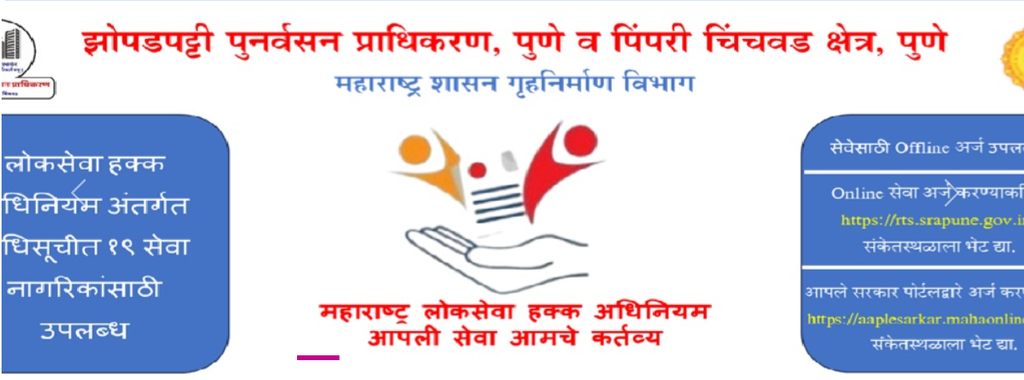
Citizens can access a range of services online through the Right to Services (RTS) portal
Services available online include:
- Legal heir registration
- Tenement transfer after five years of occupation certificate
- Registration of cooperative housing societies
- Certified copies of eligibility documents and NOCs
- Allotment through lottery
Timelines: Most services are processed within 15 to 90 days, depending on the service type.
Official Contact Details
| Detail | Information |
|---|---|
| Website | www.srapune.gov.in |
| RTS Portal | rts.srapune.gov.in |
| Phone | 020-69067900 / 918 |
| Office Address | 4th Floor, Kakade Bizz Icon, Ganeshkhind Road, Shivajinagar, Pune (near E-Square) |
| CEO | Satishkumar Khadke |
For specific scheme status, eligibility verification, documents, or grievances, always check the official website or RTS portal, or visit the office directly.
Challenges and the Road Ahead
The SRA model has clear advantages, but it is not without problems:
1. Project Delays
Many schemes take years longer than planned due to disputes, funding issues, and slow approvals.
2. Eligibility Disputes
Determining who is a legitimate resident as of 2000 or 2011 is often contested — especially when records are incomplete.
3. Coordination with Multiple Agencies
SRA projects require clearances from PMC, PCMC, PMRDA, MIDC, and other bodies. Coordination is a persistent bottleneck.
4. Quality and Maintenance
Ensuring construction quality and long-term maintenance of the new housing societies remains a challenge.
5. Non-Performing Developers
Some developers win contracts but fail to deliver. The Authority is now taking stricter action against them.
Despite these issues, the acceleration of projects in recent years — combined with clearer regulations and digital service delivery — suggests the Authority is moving toward more systematic implementation.
Why This Matters for Pune
SRA schemes are not just about housing. They have wider implications:
1. Housing Security
Thousands of families gain legal, permanent homes with basic amenities on or near the land they already occupy.
2. Urban Land Utilisation
Valuable urban land currently occupied by low-density slums is put to more productive use.
3. Infrastructure Improvement
New SRA projects come with roads, water supply, drainage, and community facilities.
4. Inclusive Growth
SRA supports low-income families without requiring large direct government spending.
If executed well, SRA schemes in Pune and Pimpri-Chinchwad have the potential to reshape how the city handles informal settlements — and provide a model for other Indian cities.
What Residents Should Do
If you live in an SRA-eligible slum:
- Verify your eligibility through the RTS portal or the SRA office
- Check the Annexure-II list for your specific scheme
- Keep your documents ready — voter ID, ration card, photo pass, and any proof of residence
- Contact the SRA office if you have questions about your status
- Be cautious of middlemen promising faster rehabilitation for a fee — always deal with the SRA directly
For the most accurate and up-to-date information on specific schemes, eligibility, or applications, refer directly to the official SRA Pune website and RTS portal.
The SRA Pune Slum Rehabilitation programme is set to expand significantly over the coming years. With 180 schemes currently active and a target of 51,000 rehabilitation tenements, the Authority’s work will shape the lives of hundreds of thousands of families in Pune and Pimpri-Chinchwad.
Sources: Slum Rehabilitation Authority (SRA) Pune official website, RTS portal, Maharashtra Housing Department notifications, and Development Control Regulations (Pune & Pimpri-Chinchwad), 2022.
Also read :-punes-best-hospitals-2026
