Pune’s AI Road Monitoring Revolution: From Grand Tour Quality Control to City-Wide Transformation
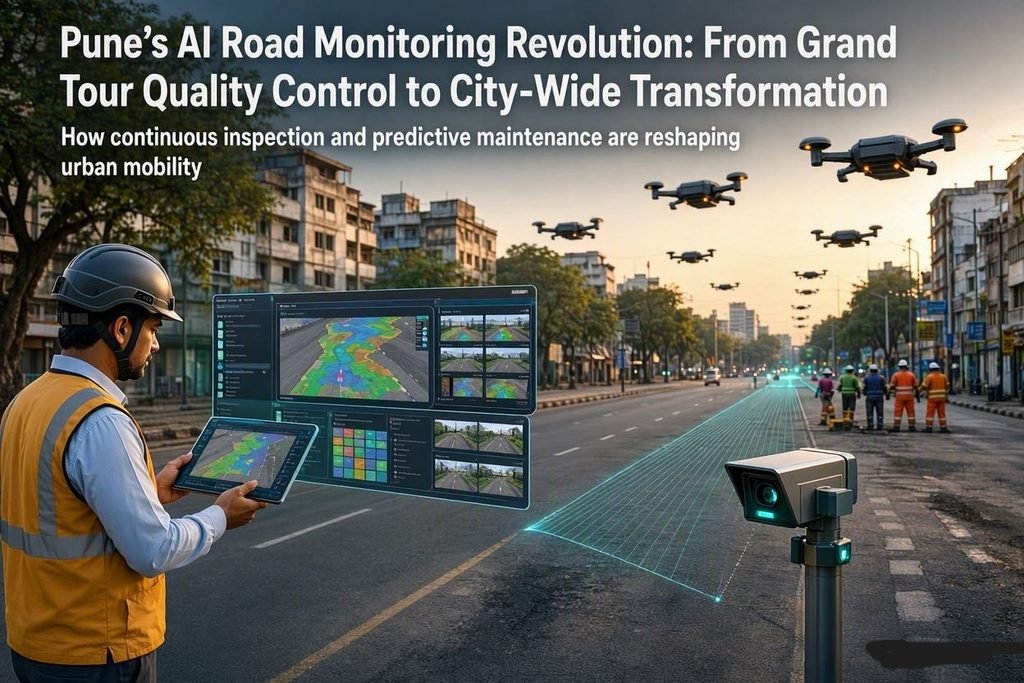
Image: AI-generated for PuneTV
Core Assessment: Pune is undergoing a paradigm shift from reactive pothole-filling to proactive, data-driven road asset management. Catalyzed by the 2027 Pune Grand Tour cycling event, the district administration has deployed AI for full-lifecycle quality monitoring for the first time, targeting five-year durability on event corridors. PMC and PCMC have built GIS-centric digital systems, but structural challenges persist—road network coverage remains at just 8% against a 15% target, the Road Mitra app was defunct for four months, and enforcement of transport recommendations sits below 10%.
I. The Grand Tour Catalyst: First-Ever Pune AI Road Monitoring
In September 2026, District Collector Jitendra Dudi announced that the Pune district administration would deploy artificial intelligence to monitor road construction and quality for the first time, as preparations began for the Pune Grand Tour cycling competition scheduled for January 2027 .
Full Lifecycle AI Monitoring
The AI system operates across every stage of road construction:
Goal: Ensure roads built or repaired for the event remain in good condition for at least five years .
Participating Agencies and Funding
Multiple agencies are collaborating: the Public Works Department (PWD), District Planning Committee (DPC), Pune Metropolitan Region Development Authority (PMRDA), PMC, and PCMC .
Funding committed: PWD approximately ₹362 crore, PMRDA ₹240 crore, DPC ₹35 crore, plus civic body contributions .
PMC’s Role: The civic body appointed Pavetech Consulting Engineering Services Pvt Ltd as technical consultant for approximately 136 km of roads and footpaths along the proposed route .
Anti-Digging Mandate
To protect newly laid surfaces, the District Collector imposed a ban on further utility digging on Grand Tour routes after the end of September 2026 . PMC and PCMC issued notices requiring all underground works (MNGL, MSEDCL, etc.) to be completed before the deadline, with heavy penalties for violations .
Context from 2026 event: Roads resurfaced for the first edition were dug up again within days of being laid, while the cycling event was still in progress . Residents in Pulgate expressed frustration: “Thanks to the cycling tour, we finally got good-quality roads. Seeing them dug it up again made me anxious” .
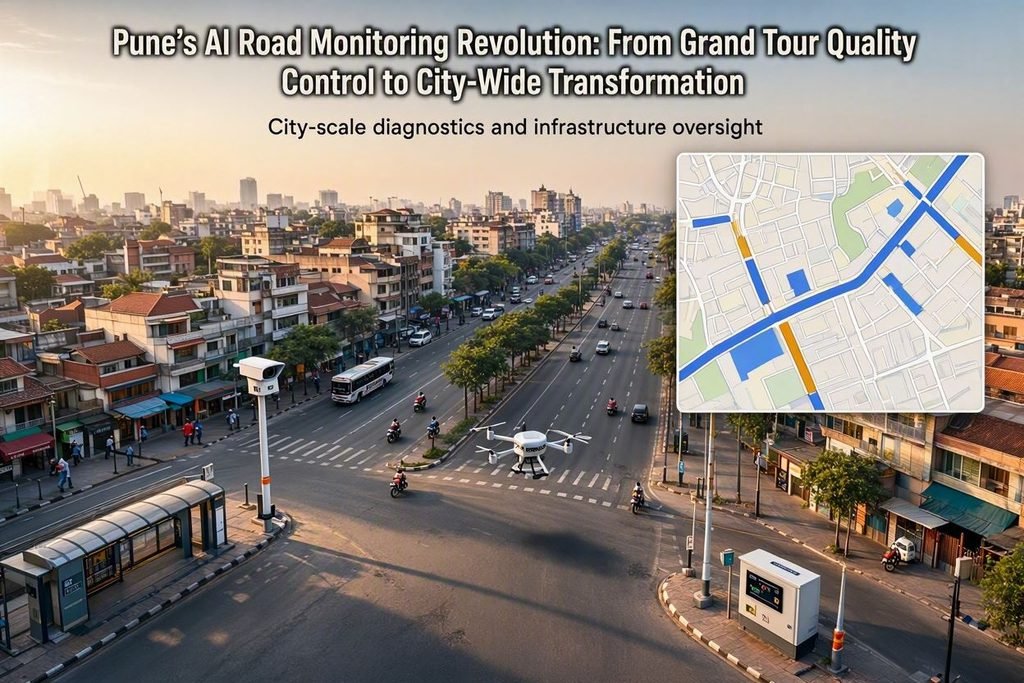
Image: AI-generated for PuneTV
II. PMC’s Digital Road Management Ecosystem
Pune AI road monitoring extends beyond the Grand Tour. PMC’s digital transformation predates the event
1. GIS + AI for Planning and Monitoring (March 2026)
Municipal Commissioner Naval Kishore Ram announced that PMC would use GIS and artificial intelligence to analyze traffic data for planning and monitoring road works through its urban mobility cells .
2.Mandatory GIS Tracking (Late 2025 Onward)
Every pothole repair and resurfacing must be logged road-wise and width-wise in the GIS system with daily updates . Senior engineers must conduct field inspections—introduced to improve accountability after complaints about incomplete or poor-quality work .
3.Pune Road Mitra App: Promise and Failure
Citizens can upload live geo-tagged photos or videos of damaged roads. Complaints reach the concerned junior engineer and remain visible to higher officials, including the Municipal Commissioner .
However, the app’s reliability has been severely compromised:
- March 2026: Road Mitra went defunct due to a technical glitch. Officials in the road department were unaware the app had stopped working .
- July 2026: The app remained offline for a fourth consecutive month. PMC attributed the disruption to a technical glitch, but residents argued it reflected “a larger problem—a sluggish response to the city’s rapidly deteriorating road network” .
- Commissioner’s claim: Naval Kishore Ram had promised potholes would be filled within 72 hours of a complaint .
- Reality: By July 2026, PMC had received over 300 road repair complaints, but commuters insisted the actual picture was far worse .
Kothrud resident Vivek Kulkarni: “This is not the first time the PMC’s road complaint app has stopped working. When the primary platform for raising complaints fails, the actual number of grievances never gets reflected” .
III. PCMC’s RAMS System: More Systematic, More Data-Driven
While PMC focuses on AI-driven quality control, Pune AI road monitoring takes a different form in Pimpri-Chinchwad
Core System: GIS-Based Road Asset Management System (RAMS)
PCMC launched RAMS in November 2024, covering approximately 1,700 to 2,073 km of road network .
Key features:
- Centralized GIS platform storing real-time data on road conditions, maintenance history, and assets (streetlights, utility poles, signage)
- Data collection using GPS-enabled vehicles with high-resolution cameras
- Focus on preventive maintenance—identifying issues before they escalate
- Linked with PCMC’s Work Management System to eliminate redundant repairs
- Annual post-monsoon surveys to guide budget planning
Automated Vehicle Surveys
In December 2024, PCMC deployed specialized automated survey vehicles (contract awarded to Pavetech on a per-kilometer basis) :
- Two vehicles fitted with six cameras and sensors
- Covered approximately 1,200 km of older roads
- Captured high-resolution images every 10 meters
- Documented potholes, cracks, broken footpaths, surface wear, and structural condition
- All data fed directly into the GIS system for prioritization
Recent Outcomes
In March 2026, based on the latest GIS/third-party survey recommendations, PCMC approved a ₹243 crore road repair plan covering nearly 306 km . The plan includes approximately 15 types of works: road resurfacing, pothole filling, footpath repairs, and preventive maintenance .
IV. The Enforcement Gap: Warnings Without Consequences
Mayor’s Audit Order
In August 2026, Pune Mayor Manjusha Nagpure ordered the municipal administration to submit a comprehensive report on road works over the past two years within eight days, including defect liability periods (DLP), resurfacing works, and repair expenditure .
The Mayor’s core concern: If the same road’s works were executed repeatedly, an investigation should be conducted, and action taken against contractors and officials .
The Data Problem
The road department does not currently have consolidated information on several critical aspects of road construction . The proposed report would include: total road length, roads developed for the cycling event, expenditure, subsequent digging and resurfacing, and DLP status .
Pothole Data
According to civic data, Pune recorded 5,931 pothole complaints in 2025, dropping to 3,230 so far in 2026 .
Ganeshotsav Pre-Event Inspection
In September 2026, just two days before Ganeshotsav, Additional Municipal Commissioner Omprakash Divte inspected the immersion procession route and found potholes, damaged footpaths, and uneven drainage chambers . He ordered all pending works to be completed within two days with geo-tagged photographic reports .
Strict warnings issued: Penal action against contractors for poor-quality work, and administrative action against negligent officials .

Image: AI-generated for PuneTV
V. Structural Challenges: What Technology Alone Cannot Solve
1.Road Network Coverage Severely Insufficient
Pune’s municipal boundaries have expanded by 330% over 30 years, but the road network covers only 8% — against a target of 15% .
2.Vehicle Explosion
The city adds approximately 1,300 vehicles per day, with total vehicles on the road reaching 8.1 million, up from 5.2 million in 2018 .
3.Transport Recommendations: <10% Implementation
A transport police report submitted to PMC two years ago called for improvements, but implementation has been below 10% . Of 90 congested junctions, plans exist for only 35; of 47 traffic bottlenecks, only 10 have been addressed .
4.Road Coverage at 9-9.5%
PMC City Engineer Aniruddha Pawaskar noted that roads account for only 9-9.5% of the city’s total area — well below the 15% required for efficient urban transport .
5.Utility Digging: The Recurring Problem
PMC’s own trenching guidelines acknowledge: “Settlement and water stagnation result into potholes, accidents and discomfort to the citizens and immense criticism to the Municipal Corporation” .
Key problems identified in PMC’s own document:
- Enforcing conditions for trenching and reinstatement is inconsistent
- Heaps of earth, rubble, and pipes are left on both sides of trenches for days
- Unauthorized excavations occur under the guise of “faults and emergencies” by MSEDCL, Water Supply, and MNGL
- Backfilling process and materials are often defective
6.Drainage Chambers: 50,000 to Fix
A citywide survey in December 2024 revealed more than 1,500 uneven drainage chambers requiring urgent attention. With over 50,000 chambers throughout Pune, PMC allocates ₹7-8 crore annually for chamber and footpath repairs, with nearly 30% dedicated solely to leveling uneven manholes .
7.Contractor Accountability: Warnings Without Action
Despite warnings from the standing committee chairman and the Municipal Commissioner, sources indicated that no action had been taken against either civic officials or road contractors for failing to respond to road repair complaints .
VI. Broader Smart City Infrastructure
Unified CCTV Network
In August 2025, over 5,450 CCTV cameras (from Pune Metro, PMRDA, and Smart City Mission) were integrated into a unified control room for real-time traffic management and crime monitoring .
Contractor Accountability: Actual Enforcement
In June 2026, the PMC Commissioner suspended two engineers for poor-quality pothole repairs and fined a contractor ₹1 million . In Warje, the contractor laid asphalt on mud without proper compaction, causing the asphalt layer to peel off .
National Precedent: NHAI Mandates AI
In August 2026, the National Highways Authority of India (NHAI) made Automated and Intelligent Machine-Aided Construction (AI-MC) mandatory for all highway projects longer than 20 km and costing over ₹500 crore .
How AI-MC works: On-board computers and sensors fitted to heavy machinery (graders, pavers, compactors) enable real-time monitoring and quality control . The technology must be deployed across every major layer—embankment, subgrade, and Granular Sub-Base .
Key concern from industry: “Unless NHAI and other agencies receive the data in real time, the impact of using this technology will be negligible. It should not be implemented in a piecemeal manner” .
VII. Assessment: The True State of Transformation
Progress Achieved
Persistent Structural Deficits
| Problem | Severity |
|---|---|
| Road network coverage: 8% vs 15% target | Extremely High |
| Transport recommendation implementation: <10% | High |
| Road Mitra app: defunct for 4 months | Medium-High |
| Road department lacks consolidated works data | Medium-High |
| DLP enforcement weak, contractors refuse repairs | Medium |
| Utility digging: recurring, weak enforcement | High |
Key Judgments
The Grand Tour is a double-edged sword. On one hand, it has forced agencies to adopt world-class standards and tight timelines, driving the first large-scale application of the AI-GIS-NDT combination . On the other hand, it may create a quality gap between “event corridors” and “ordinary roads”—international-standard cycling tracks coexisting with potholed roads citizens use daily .
PCMC’s RAMS model deserves more attention. Its systematic, continuous, and data-based approach is more solid than PMC’s fragmented push . The ₹243 crore, 306 km repair plan is based on GIS surveys—scientific decision-making rather than emergency reaction under political pressure.
Technology is not the bottleneck; execution is. Pune already has AI, GIS, CCTV, and real-time data platforms—the tools are in place. But insufficient road network coverage, disconnection between planning and execution, and difficulty enforcing contractor accountability—these root problems lie in governance structure, not technology .
The five-year durability target will test the system’s sincerity. If the five-year standard for Grand Tour routes is verified, the same AI-GIS-NDT combination could be extended to ordinary city roads . If potholes reappear on the tracks in five years, this AI revolution will have been just an expensive event performance.
Overall Assessment: Pune AI road monitoring is transitioning from reactive to data-driven. This transition has made substantive progress at the technical level—first AI deployment, RAMS system operational, unified data platforms under construction . But at the governance level, fundamental problems of coverage, enforcement, and accountability remain unresolved . The technology is in place. What determines success is the consistency of execution.
Sources:
- Pune Mirror — Grand Tour road works coverage
- Hindustan Times — PMC road management and pothole data
- Lokmat — PWD and PMRDA funding details
- PMC.gov.in — Official road works statistics
- Punekar News — PCMC RAMS system
- Esakal — Road Mitra app coverage
- ET Infra — NHAI AI-MC mandate
- NBM&CW — AI-MC technical details
- Navbharat Live — Drainage chamber survey
- Pune Times Mirror — Mayor’s audit order
Also read:-santosh-pandit-bail-pune-sessions-court
